Retaining wall drainage is the most important factor in wall stability.
A retaining wall is a vertical structure that separates two areas with different heights.
One side holds soil. The other side is open space.
No matter how tall or short it is, if it holds soil in place, it is called a retaining wall.
The Most Important Factor: Water
The most important part of building a retaining wall is water.
More specifically, it is about controlling the flow of water.
A retaining wall holds back soil.
But when water stays in the soil behind the wall, the pressure against the wall increases.
Wet soil is much heavier than dry soil.
Depending on soil type and wall height, the pressure can be several times—even many times—stronger than dry soil.
That is why it is very important to:
- Reduce how long water stays behind the wall
- Help water drain away quickly
Common Materials for Retaining Walls
Retaining walls are usually built with:
- Poured concrete
- Concrete blocks
- Wood
- Natural stone
All of these must be built with proper drainage in mind.
A Common Mistake
Some people think that adding more concrete will make the wall stronger.
They:
- Pour a thick concrete base under the wall
- Fill the inside of blocks with concrete
- Use mortar between blocks
- Sometimes even coat the back of the wall with mortar
It looks very strong.
But the wall still collapses.
Why?
Because they ignored the power of water.
Example: Concrete Blocks
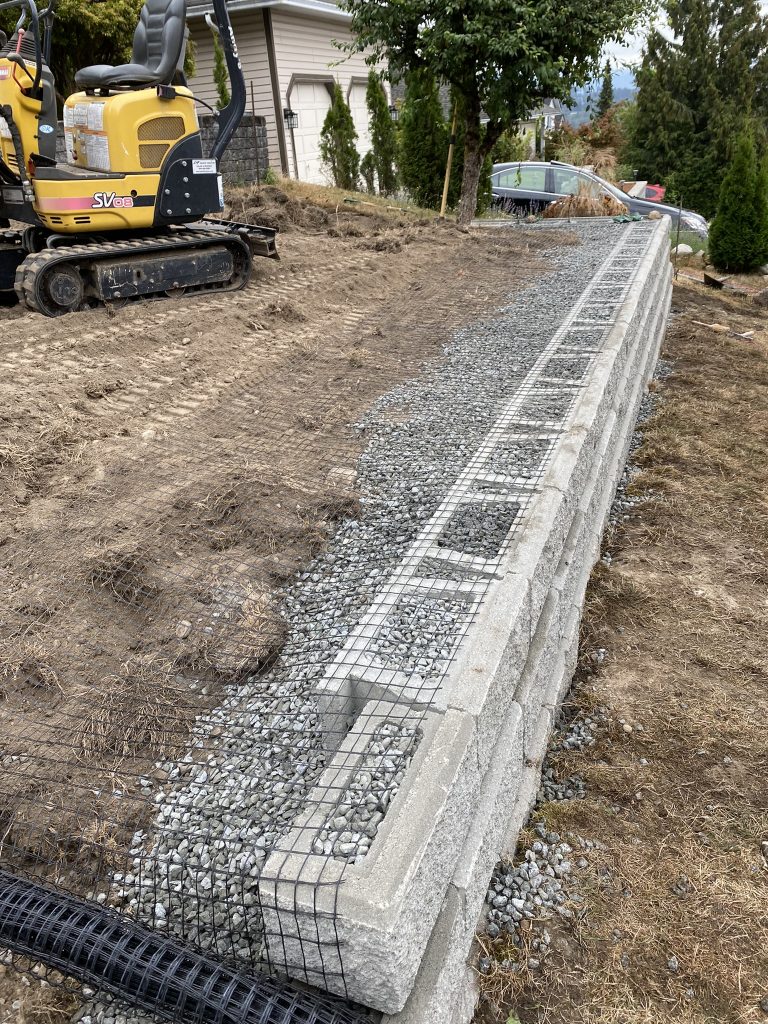
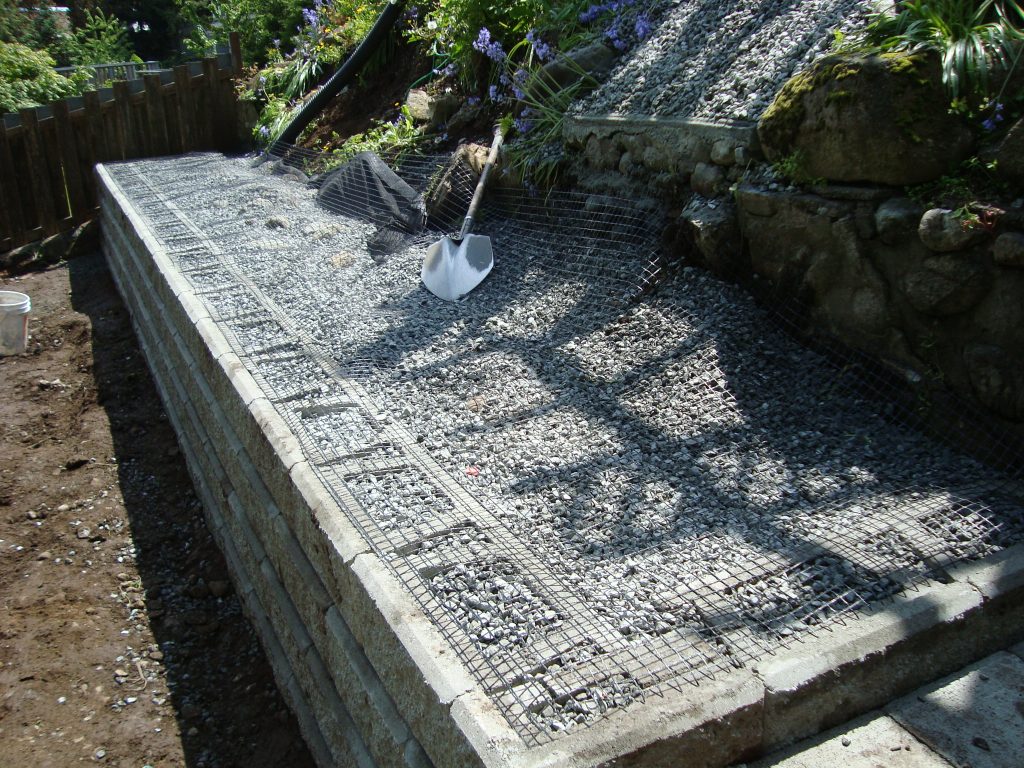
Pre-made concrete blocks sold in stores usually have:
- A hollow center
- One finished face (the other side will be buried in soil)
Many people think filling the hollow center with concrete makes the wall stronger.
But filling it with gravel actually makes it stronger.
Why?
Because the wall itself becomes part of the drainage system.
Manufacturer instructions clearly say:
- Compact a gravel base under the wall
- Install drainage backfill (gravel) behind the wall
- Sometimes add a drain pipe to help water flow away faster
If heavy structures or vehicles will be above the wall:
- The gravel layer must be thicker
- A grid-style reinforcement mesh may be added
This mesh helps hold the soil together and spreads the pressure.
Wooden Retaining Walls
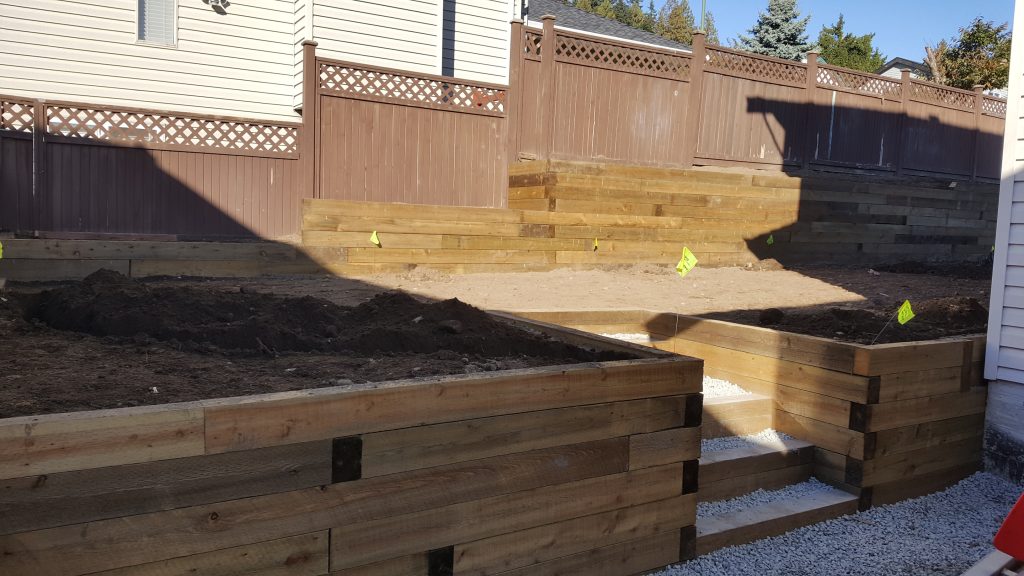
With wood walls, gravel drainage is still important.
But reinforcement bars (rebar) or deep support posts are also critical.
These posts are driven deep into the ground.
They resist the pushing force of the soil.
Simply stacking wood nicely does not create strength.
Even strong nails alone are not enough.
Why This Matters
Retaining wall work is one of the most expensive parts of garden construction.
Because of the cost, some homeowners decide to try DIY after getting several quotes.
But without understanding the power of water, walls often fail sooner than expected.
Even some inexperienced contractors skip:
- Proper drainage layers
- Reinforcement installation
This leads to collapse.
That is why:
- You must understand the construction method
- Always follow manufacturer guidelines
- Choose your contractor carefully
Water may look harmless, but in retaining walls, it is the most powerful force of all.
Written by Andy Lee
Owner of Andy’s Landscape Inc. – Landscape Contractor in Maple Ridge, BC